
This story was originally published by the Concord Bridge. You can read the story here.
Nico Calabria feigns left, then dribbles right. He dashes toward the ball.
“Yup, yup, yup,” he shouts. The soccer ball blurs as it cuts through the turf.
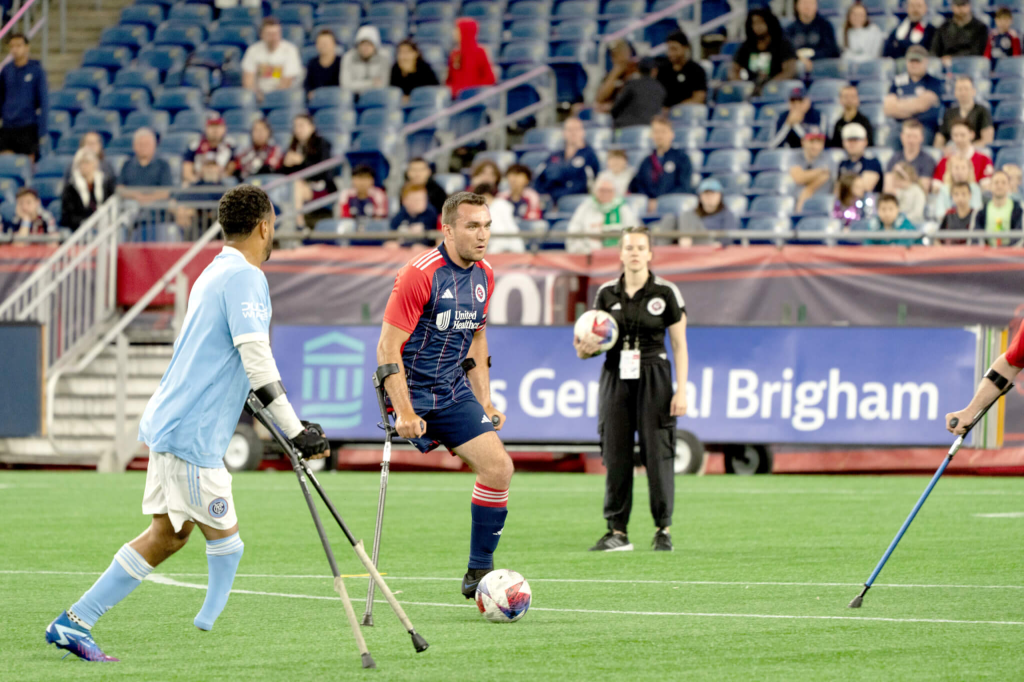
With one leg, Calabria is better than most athletes with two. He regularly amazes soccer fans as captain of both the New England Revolution’s and U.S. men’s amputee soccer programs. But he’s not looking to be inspiring as most media outlets depict; he’s looking to grow the sport.
Calabria is not an amputee, per se. He was born with one leg in 1994 in Santa Clara, California. His father, Carl, who was obsessed with soccer, encouraged Calabria to kick the ball around at a young age.
He continued playing soccer when his family moved from Indiana to Concord in 2003, but it came with challenges. Calabria, 9 at the time, almost wasn’t allowed to play after the Massachusetts State Referee Committee raised concerns about safety and “the beauty of the game,” he said.
At one point, his father padded Nico’s crutches with PVC pipe to act as shin guards.
“I have this memory of him smacking himself in the head with it in front of this group to be like, ‘Look … it’s safe,’” Calabria said.

His viral moment
Calabria would continue playing soccer at Concord-Carlisle High School, first with the junior varsity teams, then varsity. Although he spent a lot of time on the bench, during one game he scored a bicycle kick that put him on ESPN’s top 10 plays of the day.
“It kind of changed my life overnight,” Calabria said. “It was like stardom suddenly.”
After the viral goal, he starred in a Powerade commercial, which led to a free flight to the 2014 World Cup in Rio de Janeiro. He was also able to shoot free kicks with soccer star Andres Iniesta.
At 16, he traveled to Sinaloa, Mexico, to play in his first game for the national amputee soccer team. It was the first time he played with one-legged people. Suddenly he wasn’t the slowest person — he was the fastest.
“My role changed significantly, from being like a supporter of something to being like a star on the field,” Calabria said.
His whole family had come to watch the match.
“The other teammates on the Mexican team loved him, and he loved it,” his mother Jeanine said, tearing up. “That’s why they call it ‘the beautiful game,’ right?”
Similarities and differences
Amputee soccer is similar to two-legged soccer but with smaller teams and fields. Field players can have two hands but may use only one foot — not any residual limbs they may have. Goalies can have two legs but only one hand. Players can’t use their crutches as tools to make goals or trap opponents. They do kick-ins rather than throw-ins.
At 18, Calabria was named team captain. He said he became a “phenom” and one of the best players in the world, mostly because he had a lifetime of playing with two-legged people.
“A lot of people who get involved in amputee soccer, they’ve lost a leg, and they work to walk on a prosthetic leg,” he said. “Amputee soccer doesn’t allow prosthetics, so they have to learn how to use crutches.”
Amputee soccer doesn’t have as strong an infrastructure in America as it has in Turkey, which is the current world champion. He’s had to grow the sport into something bigger than it was before. In 2018, he started the New England Revolution amputee soccer team to build programs on a regional level.

Enlightening through athletics
He’s been using his background as an educator to start amputee soccer programs in New England through the Bionic Project, an instructional non-profit focused on disability education through sports.
Dana Ross Rogers, the project’s executive director, said Calabria stood out to the president and founder Will Borden after he excelled at the Bionic 5K, a road race for adaptive athletes.
“It turns out now that Nico was coming to try and recruit amputee soccer players,” Rogers laughed. “But at the time, Will [Borden] didn’t know that and just thought he was awesome.”
Calabria’s education through the Bionic Project has been significant. Bionic educators will spend a day at a pre-K to college school where they aim to dismantle disability bias through adaptive sports, like amputee soccer. They recently visited an ad strategy class at Boston University.
“He is magical in a classroom,” Rogers said. “He’s aware that everything with a child is a teachable moment, and his expertise and professionalism in the classroom is unparalleled.”
‘We’re doing it’
He’s proud of his success on the soccer pitch, but he’s prouder of the work he’s done off the field. He organized the first U.S. amputee soccer cup in the states and has had his hands in programs nationwide.
“It was the first time in my life that I had watched a game of amputee soccer that I wasn’t playing in,” Calabria said. “I was just standing there and looking around at all these people that I’d met around the country, and been like, ‘OK, this is sweet. We’re doing it.’”
Calabria led the Revolution to a 5-0 victory over New York FC last month. Leading up to the game at Gillette Stadium, he was unfazed.
“They’re itching for a win. … They haven’t beaten us in their history, and they’re tired of it,” Calabria said. “When the lights go on, I’m gonna go out and play really hard and try to put on a show, but it’s all love between the two teams.”
This story is part of a partnership between The Concord Bridge and the Boston University Department of Journalism.
 Gabriel Martins
Leave a comment